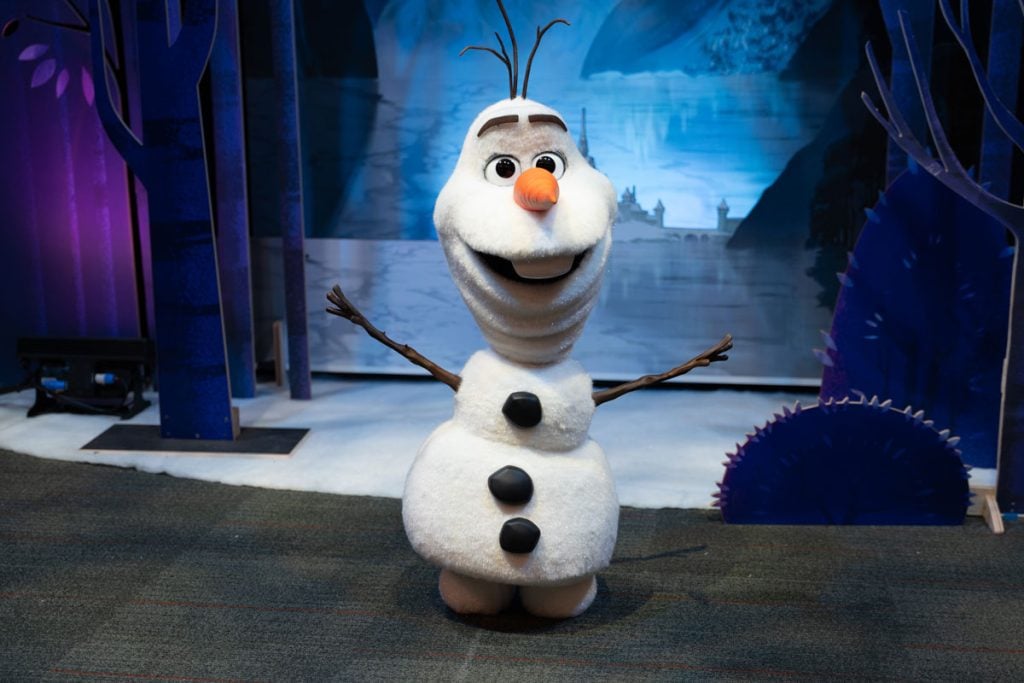
Guests visiting Disneyland Paris later this month will soon meet a very special version of a familiar snowman. But before making his theme park debut, Olaf – the self-walking robotic character developed by Walt Disney Imagineering Research & Development – made a surprise appearance at one of the world’s biggest artificial intelligence events.

The free-roaming robotic Olaf recently stopped by the keynote presentation at NVIDIA GTC 2026, a global conference that’s focused on artificial intelligence and emerging technology. During the event, NVIDIA President and CEO Jensen Huang was joined onstage by the absolutely adorable animated snowman, giving attendees an exciting look at the technology behind Disney’s newest character innovation.
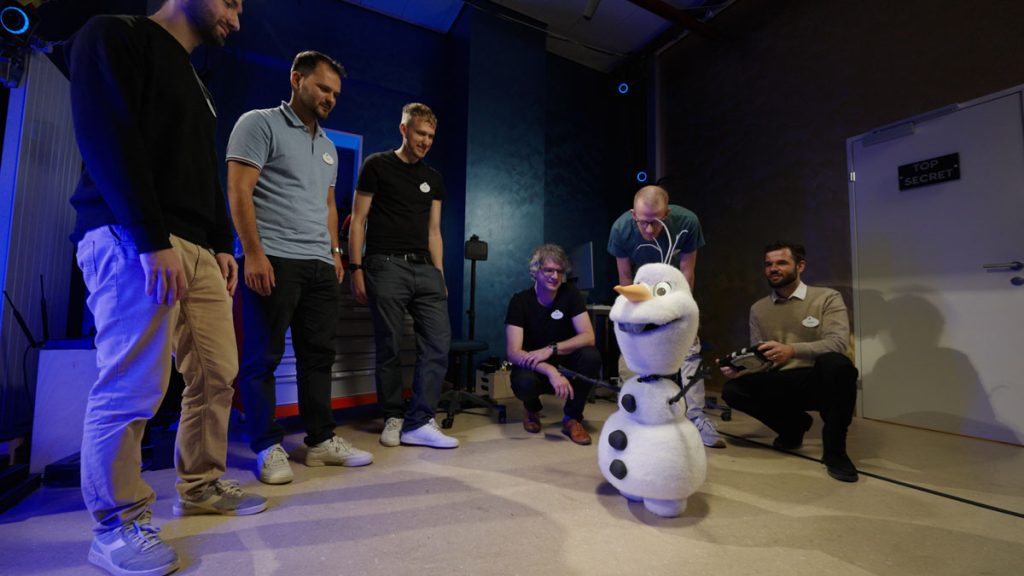
Olaf was first introduced publicly in an episode of the We Call It Imagineering series, highlighting the work happening inside Walt Disney Imagineering’s Research & Development division. The character was brought to life using the NVIDIA Newton Physics Engine, with Imagineers collaborating closely with Walt Disney Animation Studios to ensure Olaf’s movements and expressions stayed true to the character audiences know from the Frozen films.
Unlike traditional animatronics, this version of Olaf can walk and move freely, thanks to advanced robotics and deep reinforcement learning. Through simulated training environments, the character learned how to balance, walk, and gesture in a fraction of the time it would normally take.
Olaf’s design also allows for a high level of expressiveness. His mouth and eyes are fully articulated so he can speak and interact with guests, while his arms, nose, buttons, eyebrows, and even his twig “hair” are magnetically attached to allow for playful character gags.
The robotic snowman will soon begin greeting guests inside World of Frozen, the new immersive land opening March 29 at Disneyland Paris. Olaf will appear as part of the Celebration in Arendelle show, which takes place on a boat in the lagoon.

Disney recently spoke with Kyle Laughlin, SVP of Research & Development and Technology & Engineering at Walt Disney Imagineering, about the technological breakthroughs that helped bring Olaf to life.
Now that Olaf is about to make his guest-facing debut at World of Frozen, what obstacles did R&D face in advancing Olaf’s movements and how were they overcome?
“We’ve been hard at work to make sure Olaf is ‘show ready.’ He is such a unique character – he is made of snow, moves in non-physical ways, and he has snowball feet. Olaf will be debuting at World of Frozen as part of the daily Celebration in Arendelle show, which takes place on a boat in the lagoon. This meant he had to learn to balance on an unstable surface. Through deep reinforcement learning, in just a matter of hours, he earned his sea legs.”
Tell us about the continued work you’re doing with NVIDIA and Google DeepMind, specifically the progress on the Kamino simulator Disney Research developed.
“The Kamino simulator is a GPU-accelerated physics solver designed for accurate simulation of complex mechanical systems. Kamino enables large-scale reinforcement learning by running thousands of parallel environments on a single GPU, including inhomogeneous worlds where each environment can contain a structurally different robot. Deep reinforcement learning through simulation allowed Olaf to learn to stand and walk in challenging environments, like on a boat, in a fraction of the time it would take a human child.”
Are there plans to use Kamino to develop and train new robotic characters? Are there specific characters you’re excited to explore next?
“Kamino is designed for simulating complex mechanical systems that go beyond simple kinematic trees, which are basically maps of connections that inform the ways in which the robots move. If you think about all the tools in our Imagineering toolbox, Kamino is another that will help us solve real world problems and physical challenges. The speed at which we’re able to create new characters – and get them in front of our guests – is unprecedented. We are working to bring more emotive, expressive, and surprising characters to guests at our parks and ships around the world.”
In addition to Olaf’s keynote appearance, Disney Research is also participating in several sessions during the conference. Moritz Bächer, Director of Disney Research Lab Zurich, is presenting “Disney’s Robotic Characters: From the Screen to Reality via Physical AI,“ and will later join representatives from NVIDIA, Google DeepMind, and Skild for a panel discussion focused on the open-source Newton physics engine that helped bring Olaf to life.
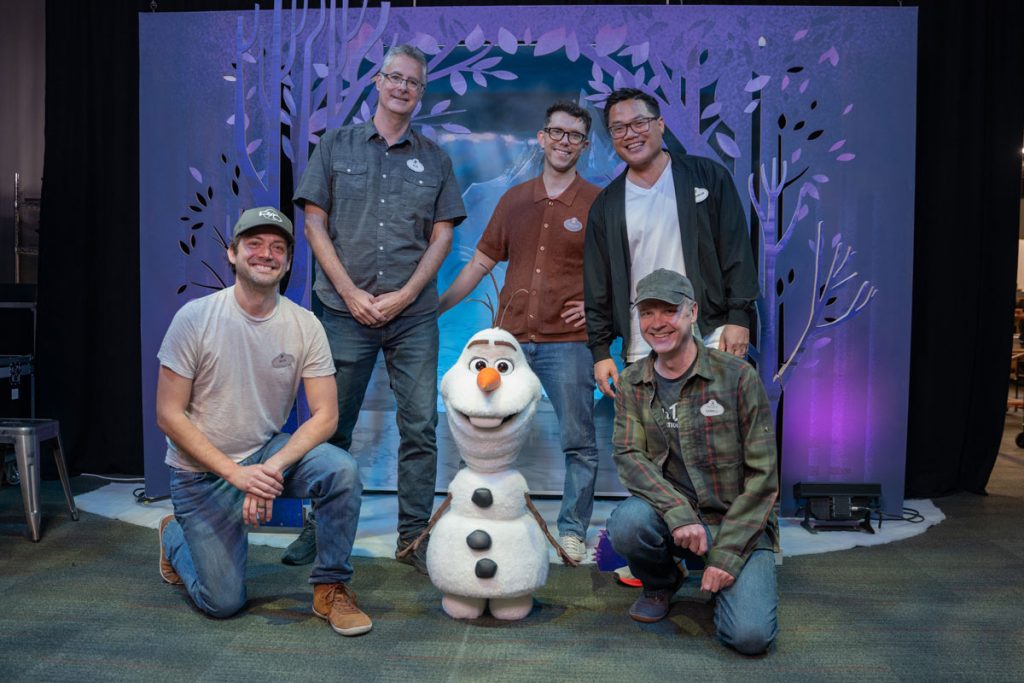
After the conference wraps up, Olaf will soon head to Arendelle – where guests visiting Disneyland Paris will get to experience Disney’s latest robotic innovation firsthand.